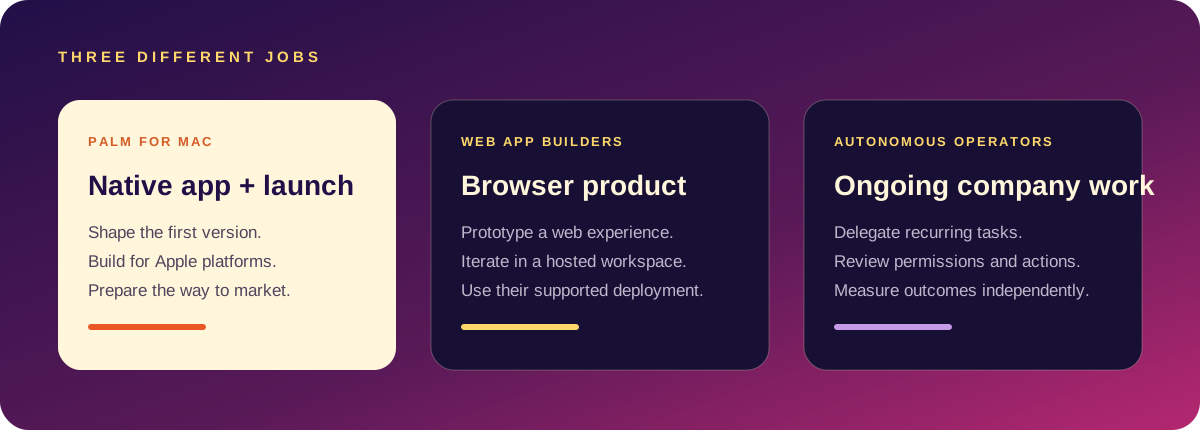
A native Mac launch studio for shaping the product, visual direction, first version and marketing path. Your project stays close to your files and decisions.
A cloud AI cofounder positioned around building, marketing and operating a company through continuous tasks.
You are still deciding what the product should be, value local work, or want to stay the maker making the important calls.
The practical difference
Polsia is designed to take more of the operating loop away from you. Palm is designed to make the loop clearer before you commit to a build, a launch or a public promise. One is an autonomous operator; the other is a private launch studio.
Why Palm exists
A smaller product can be a strength when the idea needs room to change. Palm turns one sentence into a coherent first version, a landing-page story and the next distribution experiments without pretending that a generated plan is the same thing as customer evidence.
Choose Palm for a maker-led build
Palm suits a founder who wants to shape the product, build a native Apple-platform app on the Mac, inspect the project, and prepare launch materials while staying involved in the important decisions. It is not a promise of a hands-off company or automatic customer acquisition.
Choose an autonomous operator when delegation is the goal
If you want an online system to handle recurring company tasks, evaluate Polsia’s current permissions, review steps, integrations, costs, and the actions it can take before connecting business accounts. Automation is most useful when you can see what it will do and retain control over consequential actions.
Could they work together?
Potentially: use Palm to make the product direction and first native build concrete, then decide whether an operating platform is useful for ongoing business tasks. Do not assume generated marketing or a deployed product has been validated; check customer behavior and results independently.
Read Polsia’s current product description, then compare Palm with an AI app builder.
Two different promises
| An autonomous operator such as Polsia | Palm | |
|---|---|---|
| Promise | Runs tasks for you with little involvement | Builds with you, step by step |
| Your role | Set goals, review outcomes | Describe, review, change, approve |
| Where it runs | A hosted service | Your Mac |
| Output | Ongoing operations and content | A native iPhone app, an Xcode project and launch drafts |
| Control | Delegated | Nothing is published until you approve it |
This compares approaches. For what Polsia does today and what it costs, check its own site.
Questions to ask about any autonomous tool
- What can it do without asking me?
- What accounts and data does it have access to?
- How do I see what it did, and undo it?
- What happens to my business if the service stops?
When hands-on is the better choice
Early in a product, the decisions are the work: who it is for, what it leaves out, how it is described. Delegating those rarely goes well. A maker-led tool keeps you in them and takes the typing away.
Palm is a Mac app that turns a sentence into a native SwiftUI iPhone app, an Xcode project and launch material, with the AI running on your Mac. Pro is $49 once. It needs macOS 26 and Xcode. More in the builder guide and the idea-to-launch plan.
A staged way to use both ideas
- Build it yourself first. Use a maker-led tool while the product is still being decided, so every choice is yours.
- Run it by hand for a while. Answer the first support emails and write the first announcements yourself. You learn what users actually ask.
- Delegate what has become routine. Once a task is the same each time, it is a fair candidate for automation, with a review step for anything customers see.
Autonomy is most useful after you know what good looks like. Before that, it produces confident work nobody has checked.
Questions people ask
Does Palm act on its own?
No. It drafts and builds; you approve.
Could I use both?
Yes, for different stages: building the product yourself, then delegating routine operations later.