 Show My Vet
Practical guide
How to count your dog or cat's resting breathing rate
If your pet has a heart or breathing condition, your vet may ask you to count breaths at home. It takes 30 seconds and needs nothing except a clock. Here is how to do it so the number is useful.
Why vets ask for it
A pet's breathing rate at rest is one of the few things you can measure reliably at home. A count taken in the clinic is often higher, because the animal is awake and unsettled. Counts taken at home, while your pet is asleep, give your vet a calmer baseline and show whether anything is changing between visits.
Researchers have looked at this directly. In one study, owners of 51 dogs and 22 cats with stable, medically controlled heart failure counted breaths at home, and most of those animals averaged under 30 breaths a minute while asleep or resting (Porciello et al., The Veterinary Journal).
How to count
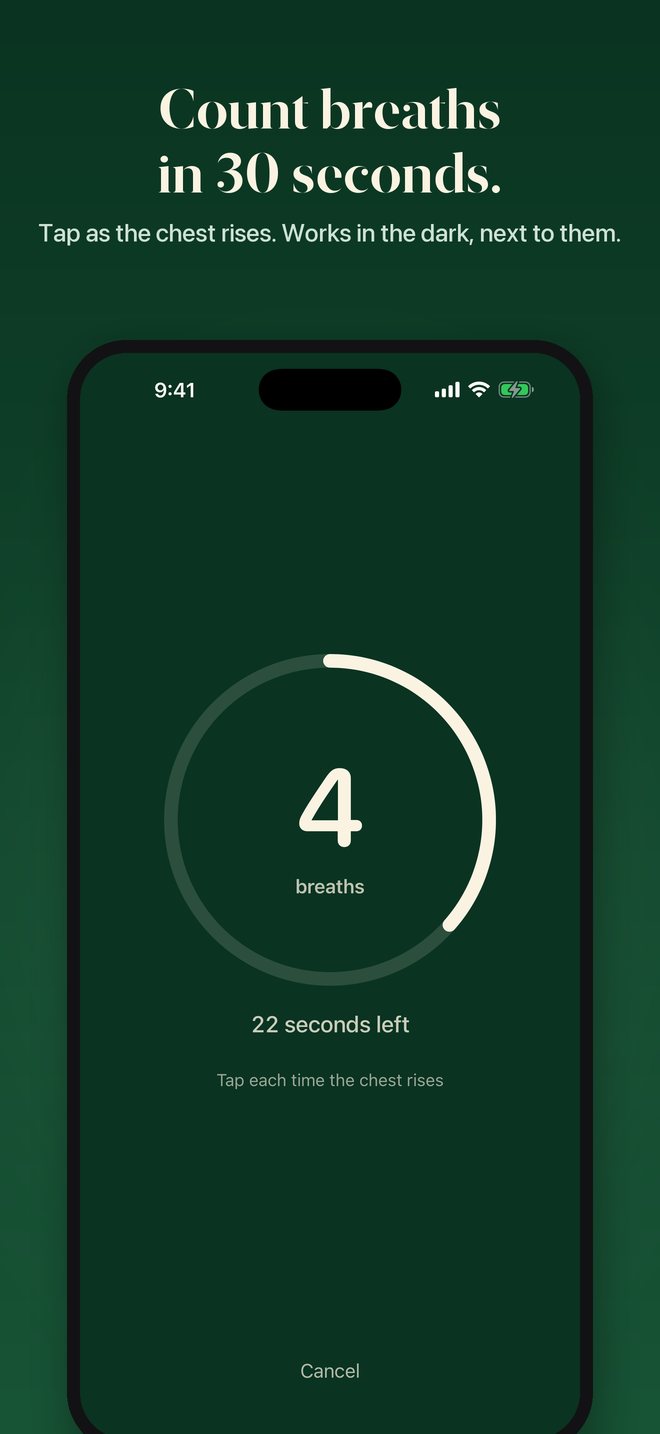
- Wait until your pet is truly at rest. Asleep is best. Avoid counting after exercise, in the heat, or when your pet is excited or anxious.
- Check they aren't panting, or purring. Panting doesn't count, and a purring cat is hard to read accurately.
- Watch the chest or belly. One breath is one full rise and fall. Count the rises, not the rises and falls separately.
- Count for 30 seconds and double it. Twelve breaths in 30 seconds is 24 breaths a minute. Count for a full minute if the breathing is slow or uneven.
- Write down the number, the date and the time. A single number says little. A week of them says a lot.
What's a normal number?
VCA Animal Hospitals describes a normal rate while resting calmly or sleeping as 15 to 30 breaths a minute, and treats rates consistently above 30 as increased. VCA also points out that for some individual pets, your vet may consider a lower number too high. That's why the number that matters is the one your own vet gives you, for your own pet.
Getting a number you can trust
- Count at about the same time each day, in the same conditions. Late evening, once your pet has settled, works for many households.
- Watch the trend, not one reading. Dreams, a noise outside or a shift in position can all nudge a single count.
- Agree the plan in advance. Ask your vet how often to count, what number to watch for, and what to do if your pet goes over it.
- Take the record to appointments. A list of dated counts is more useful than "it's seemed a bit fast lately".
Keeping the record in Show My Vet
Show My Vet is an iPhone app for showing your vet what happens between visits. To count, you tap each time the chest rises, on a dark screen made for use next to a sleeping pet. The app times the gaps between your taps and works out breaths a minute. It also flags uneven tapping, in case a breath was missed or your pet moved.
Counting, every saved count and a daily reminder are free for your first pet. The Family upgrade adds a chart of the trend with weekly averages, and an alert straight after any count above the number your vet gives you. Counts also appear in the one-page vet brief and its PDF, alongside any seizures, coughing fits or other symptoms you've logged.
Show My Vet doesn't diagnose or tell you what a number means. It keeps the record, and your vet interprets it.