To use trade signals responsibly: treat each one as a prompt to check, not an order. Confirm it is recent and that price is still near the entry, know the stop loss before you enter, size the position so a stop-out costs a small fixed fraction of your account, decide your exit in advance, and record every trade, including the ones you skip. Review the record monthly. This is general education, not financial advice.
A sixty-second checklist
- How old is it? A scalp signal from forty minutes ago is history.
- Where is price now? If it has already run most of the way to the target, the risk and reward have changed.
- Where is the stop? If you would not accept that loss, do not take the trade.
- Does it fit the bigger picture? A long against a strong downtrend needs more caution.
- Is there news due? Scheduled announcements can override any setup.
- Am I calm? Chasing a loss or a missed move is a reason to skip.
The free signal checklist is a printable version.
Position sizing from the stop
The standard approach is to fix the amount you are prepared to lose on one trade, then work back to the position size.
| Step | Example |
|---|---|
| Account | $5,000 |
| Risk per trade (1%) | $50 |
| Entry | $3,400 |
| Stop loss | $3,332 (2% below) |
| Loss per unit if stopped | $68 |
| Position size | $50 ÷ $68 ≈ 0.735 units, about $2,500 |
The numbers are an illustration, not a recommendation. Many traders risk between half a percent and two percent per trade; what is right for you depends on your circumstances. Leverage multiplies both sides and makes liquidation possible before your stop. Fees and slippage make real losses a little larger than the sum suggests. The risk sizing worksheet does the arithmetic.
Decide the exit before the entry
- Place the stop when you enter, not later.
- Do not move a stop further away to avoid being stopped out.
- Know whether you will take all profit at the target or part of it.
- Set a time limit: if nothing has happened within the signal's timeframe, the idea has probably expired.
Keep a diary
| Record | Why |
|---|---|
| Signal, direction, timeframe | To see which kinds work for you |
| Your entry and exit | They differ from the signal's |
| Outcome: win, loss, skipped | Skips reveal as much as trades |
| Reason and mood | Patterns in your own behaviour |
In SignalFlare, tapping a signal opens the diary entry with the signal's levels already there, and you mark it win, loss or skipped with prices and notes.
A monthly review
- Win rate, and average win against average loss. A 40% win rate is fine if wins are twice the size of losses.
- Results by market and by style: scalp or swing, long or short.
- How often you broke your own rules, and what it cost.
- Whether following the signals is worth the subscription and your time. If not, stop.
Common mistakes
- Entering late because the notification was seen late.
- Sizing by feel.
- Taking every signal.
- Increasing size after a loss.
- Judging a signal source on a handful of trades.
- Trading money needed for something else.
Free worksheets on this site: a crypto signal checklist, a risk sizing worksheet and a market brief template.
About SignalFlare
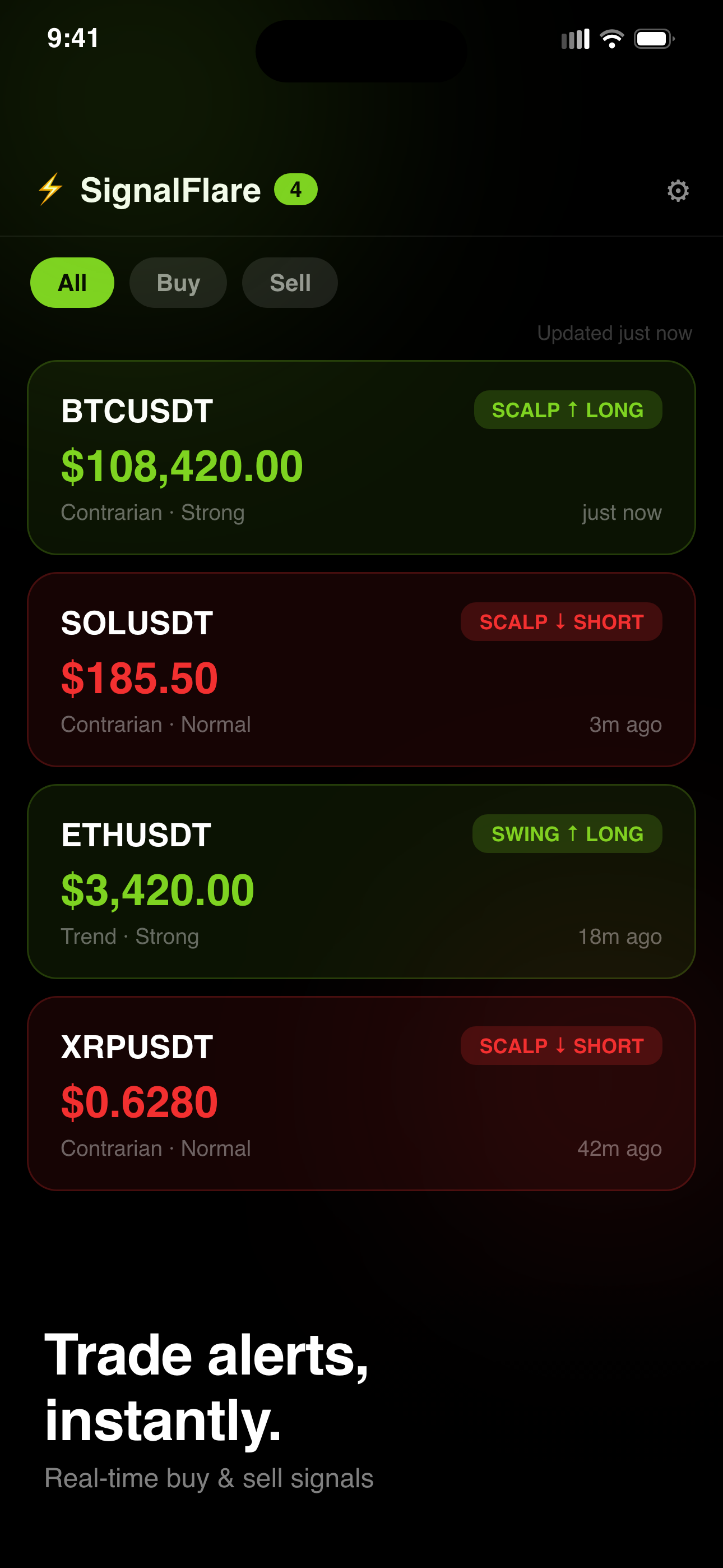
SignalFlare sends curated crypto signals to your iPhone with entry, stop loss and take profit levels, and includes the diary described above. More in the app guide.
SignalFlare is an iPhone app. A 3-day free trial unlocks live signals, notifications, the trade diary, widgets and Dynamic Island. After the trial, access and notifications stop unless you subscribe, weekly or yearly, at the price Apple shows at purchase. You can cancel in your Apple Account settings.
Common questions
Should I take every signal?
No. Use a checklist and skip the ones that do not pass.
How much should I risk per trade?
That depends on your circumstances. The method is to fix a small percentage and size from the stop. This is not advice.
Can signals guarantee profit?
No. Any service that says so is misleading you.
Why record skipped signals?
To learn whether your filter helps or hurts.
Does SignalFlare size positions for me?
No. It shows the levels. Sizing is your decision.
SignalFlare's signals are for information and education only. They are not financial advice or a recommendation to buy or sell anything. Crypto trading carries a high risk of loss, past signals say nothing reliable about future ones, and you are responsible for your own decisions. Only trade money you can afford to lose.
Follow signals with a process: Get SignalFlare.