ShadowCoach checks three parts of your form through the iPhone camera: whether your hands return to guard after each punch, whether your chin stays tucked, and whether your hip turns on the cross. It calls short cues during the round and gives a form score out of 100 afterward, based mainly on guard discipline. It sees one camera angle, so treat it as a habit check alongside coaching, not a full technical assessment.
The three things it checks
Guard recovery
After every punch, the app looks for the hand coming back to your face. If it hangs low, you hear "Hands back to guard" or "Bring both hands home after every punch". This is the biggest part of the score, because it is the habit most likely to get you hit.
Chin position
A lifted chin is flagged with "Chin down". The camera compares your head and shoulder positions through the round, so the cue comes when your posture changes, typically as you tire.
Hip rotation on the cross
Rear straight punches are checked for hip turn. An arm-only cross gets "Rotate your hip on each cross and let the rear heel turn with the punch".
Each cue is a few words long by design. You are mid-round and breathing hard, and a paragraph of advice would be useless.
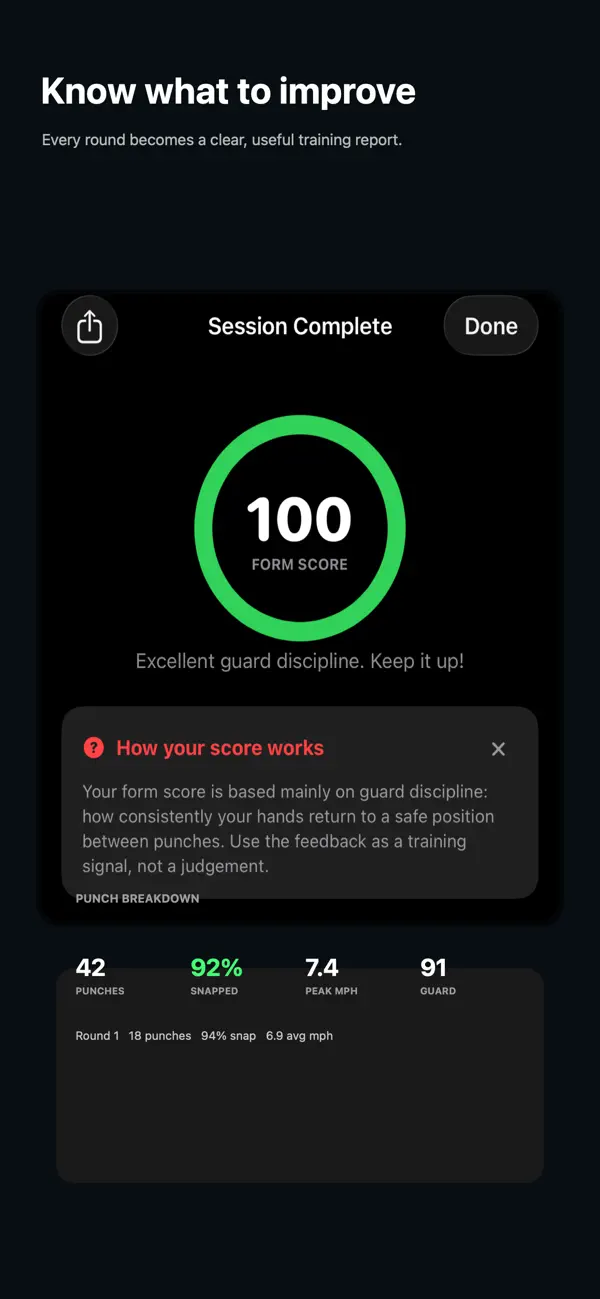
How the form score works
At the end of a session you get a number out of 100. The app states what it is: a score "based mainly on guard discipline: how consistently your hands return to a safe position between punches". It also says to use it "as a training signal, not a judgement".
That narrowness is deliberate. A camera can measure guard recovery reliably from the front. It cannot reliably judge everything a coach would look at, so the score does not pretend to. Read it as "how disciplined were my hands today", and compare it with your own previous sessions, not with other people.
Beside the score you see total punches, a guard figure, and a breakdown per round, which shows whether your guard held up in round three as well as it did in round one.
What it cannot see
- Anything behind your body. From the front, a rear elbow that flares or a foot that crosses is partly hidden.
- Weight transfer and balance. These need a trained eye, or at least a side-on video.
- Footwork. The app does not score your feet. The footwork drills guide covers that separately.
- Whether a technique suits you. Styles differ. A coach adapts; an app applies one rule.
If a cue keeps firing and you believe you are doing it right, check your camera setup first, then ask a coach to watch.
Getting reliable feedback
- Prop the phone at chest height. A shelf, a tripod or a water bottle on a bench all work.
- Stand 2 to 3 meters back. The camera needs your whole body, including both hands at full reach and your hips.
- Face a light source. A window or lamp in front of you is better than one behind you. The app warns you before the round if the picture is too dark.
- Be the only person in frame. Mirrors and people training behind you can confuse the tracking.
- Run the calibration. It checks that your hands and shoulders are visible before the first bell.
Using replay to check yourself
Premium adds session replay. You watch the round back with the skeleton overlay and the moments that triggered a cue. Watching yourself is often more convincing than being told: the low left hand you were sure was up is right there on screen. Replays can be exported as video, which is a practical way to show a coach a round they were not present for.
A simple way to use it
- Pick one thing for the session, such as guard recovery.
- Run three Freestyle rounds and listen for that cue only.
- Look at the per-round breakdown afterward. Did the cues cluster in the last round?
- Next session, repeat with the same focus until the cue goes quiet, then move on.
One fault at a time is how coaches work, and it works the same way here. The shadowboxing workout guide has round structures to slot this into.
Free version and Premium
| Free | Premium |
|---|---|
| Round timer with spoken round calls | Live coaching cues and punch feedback |
| Skeleton overlay and punch counts | Session replay with form corrections |
| Three training sessions a week | Unlimited sessions |
| Combo of the day and the Punch Guide | Four-week plans, trends, saved custom combos, Apple Health export |
Premium is available weekly, yearly or as a one-time lifetime purchase. The yearly plan starts with a 7-day free trial and the weekly plan with a 3-day trial for new subscribers. Check the App Store for current prices.
Common questions
Is the feedback live or only afterward?
Both. The skeleton overlay and punch count are live for everyone. Spoken coaching cues during the round and replay afterward are Premium.
How accurate is it?
It is reliable for guard recovery from a front-on camera in good light. Punch classification is good but not perfect, especially for tight hooks and fast doubles. It is a training aid, not an official judge.
Can it check my footwork?
No. It tracks upper-body mechanics: punches, guard, chin and hip rotation.
Will it work with a heavy bag?
It is designed for shadowboxing. A bag can block the camera's view of your hands, so tracking is less dependable.
Can I show the results to my coach?
Yes. The session summary can be shared as a card, and Premium replays can be exported as video.
ShadowCoach is a training aid, not a substitute for a qualified coach or medical advice. Check with a doctor before starting a new exercise routine, and stop if you feel pain, dizziness or chest discomfort.
Find out what your hands do when nobody is watching: Get ShadowCoach on the App Store.