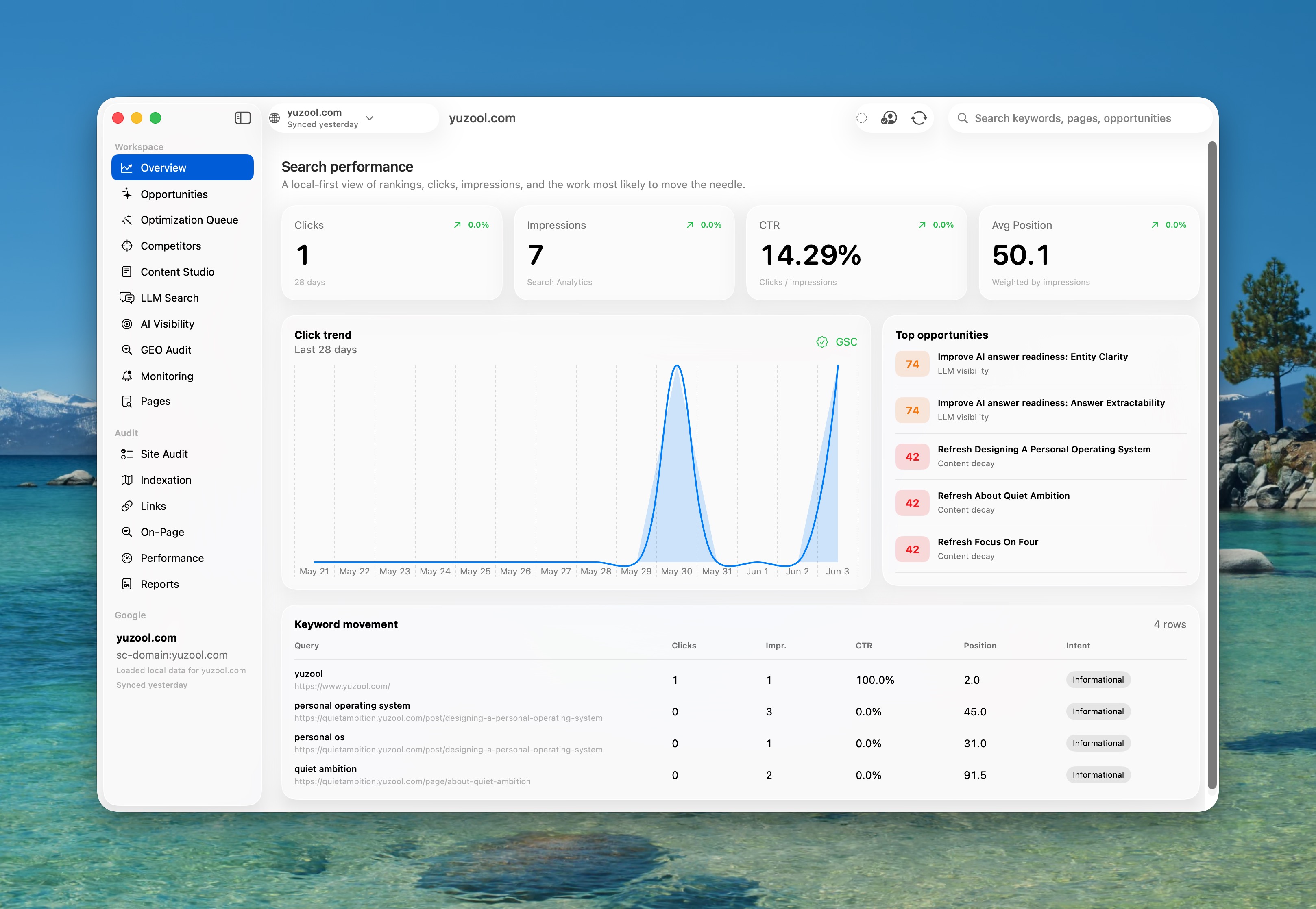
Most early sites have the same awkward problem: there is enough data to feel busy, but not enough volume to make a dashboard feel statistically impressive. Yuzool is in that phase too. In the latest 100-visit Tinylytics snapshot, the homepage and Rank page were tied at 21 visits, while Google referred 13 visits. That is useful evidence, but it is not a victory lap.
The useful question is not “did traffic grow this week?” It is “which page should earn the next 100 visits, and what single change will make those visits more useful?”
1. Pick one page with a real signal
Open Search Console and look for a page that already has impressions or a few clicks. Do not begin with the page you happen to like most. Begin with the page where a small improvement could create a meaningful next action: a product page, a comparison page, or an answer to a narrow question.
For each candidate, write down the query, impressions, clicks, CTR, average position and the promise the page currently makes. This turns “SEO” into a decision someone can review.
2. Change one thing, not the whole site
Choose one intervention: rewrite the title, clarify the first paragraph, add a specific internal link, answer the obvious follow-up question, or make the purchase path visible. If you change all five, you will not know what helped.
Weak experiment
Redesign the template, publish six articles, change every title and then check traffic tomorrow.
Useful experiment
Rewrite one title for one query, record the date, and check impressions, CTR and product-page intent after 7, 14 and 28 days.
3. Measure intent before revenue
A low-traffic site needs leading signals. Track the page view, the click to the demo or start-here page, the checkout visit and the purchase separately. A page that earns a qualified product-page visit has taught you something even if it has not sold yet.
On Yuzool, the Rank page now exposes the direct $39 purchase path and keeps the $49 human launch audit as a secondary option. That is a testable change: the next review is checkout intent, not another intermediate click.
4. Publish the result, including the boring part
A weekly note should include the baseline, the decision, the date shipped and the next check. If the result is flat, say so. A small public record is more useful than a vague claim that a site is “growing.” It also gives future buyers a way to see how the product works before they download it.
A simple weekly worksheet
- Signal: one page, query and baseline.
- Change: one edit with a reason.
- Measure: impressions, CTR, qualified clicks and checkout intent.
- Review: 7, 14 and 28 days, labelled win, loss or inconclusive.
- Next: keep the change, revise the offer or choose the next page.
A focused Mac workflow
Turn the next 100 visits into a decision.
Rank brings Search Console data, local checks, change tracking and reviewable SEO actions into one Mac workspace. It is designed for the stage where every useful visit matters.
Buy Rank — $39 onceSee the workflow first