Scribblebay guide
Draw music online: turn a drawing into a song
To draw music, draw on a loop that plays from left to right: higher on the paper plays a higher note, and drawing faster plays quicker notes. In Scribblebay every note is kept in key and on the beat over drums and chords, so whatever you draw sounds like a song.
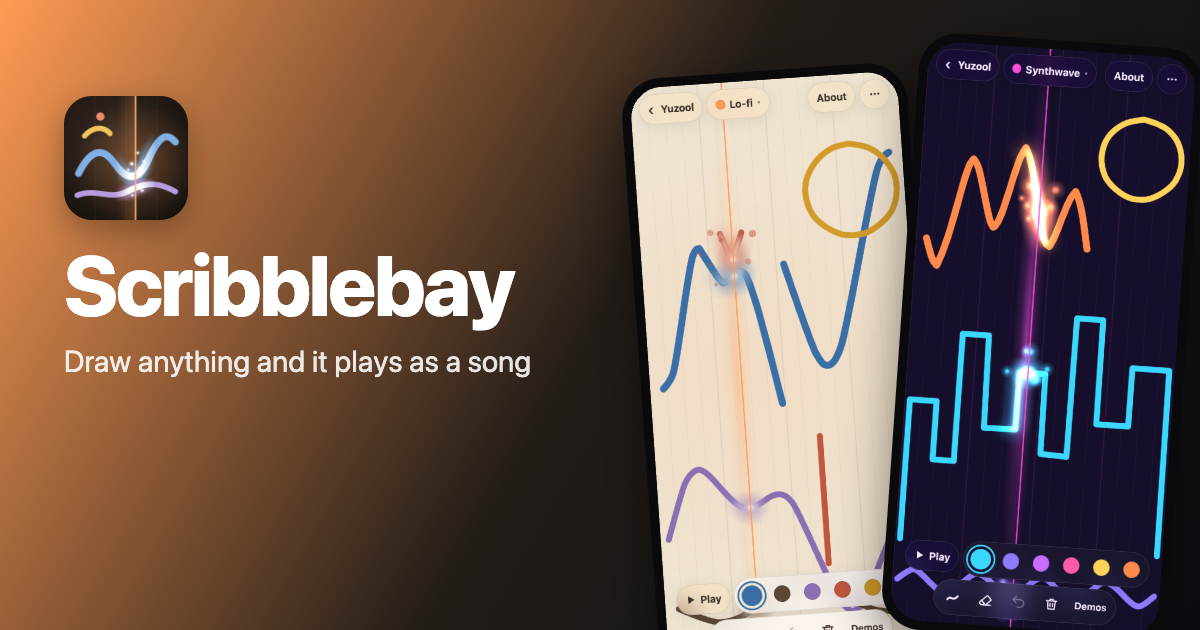
The paper is four bars of music
The page you draw on is a loop of four bars. A glowing line, the playhead, sweeps from left to right and plays whatever it crosses, then comes round again. Left to right is time: something drawn at the far left plays at the start of the loop, something in the middle half-way through. The faint upright lines mark the beats and the bars.
Underneath your drawing, the paper already plays a band: drums, a bass line and chords that change every bar. That is why even a blank page is music, and why your line always has something to sit on.
What each kind of mark plays
- A line is a melody. Its height sets each note: higher plays higher. Every note is moved to the nearest note of the key, and on the beat to a note of the chord playing there.
- Speed is rhythm. Draw quickly for fast notes, slowly for long held ones. The notes still land exactly on the beat.
- A tap is one note. Tap a few times for a little tune, or scatter taps like raindrops.
- Up and down is a chord. A line drawn straight up or down strums the chord there, low to high or high to low as you drew it.
- A loop is two parts. A circle plays its top and its bottom together, moving apart and back. A zigzag bounces between high and low.
- A scribble is a drum fill. Scribble back and forth in one spot for a fill there: the snare higher up, the toms lower down.
- Colour is the instrument, thickness is loudness. Each colour plays its own instrument; a thick line plays louder than a thin one, and an Apple Pencil’s pressure does the same.
Choose a style
The paper sets the style: its tempo, its key and chords, its drums and the instrument on each colour. Lo-fi is slow and swung, with an electric piano and an upright bass. Pop is bright, with a real drum kit and a piano. Ambient drifts, with a harp and long chords. Synthwave drives with synths at night, Funk tightens up with a real kit and an electric bass, and Lullaby goes soft with a harp, strings and a flute. Change the paper and the same drawing plays in the new style and key.
Tips for drawing a song that sounds good
Give the song a shape: a low, slow line along the bottom in the bass colour, a few chords drawn straight up and down, and one melody across the top. Leave some space: a busy page plays busy music. Draw the melody at a steady speed for a steady rhythm, and quicker where you want a run. Two lines that cross make two parts that answer each other.
Stuck for a start? The Demos sheet has eleven drawings of ours, from a city skyline played as chords to raindrops on a window. Open one, listen, then draw over it.
Questions
Do I need to know music to draw a song?
No. Every note is moved to the key and onto the beat for you, so any line sounds like part of the song. Knowing music helps you aim, but nothing you draw can play a wrong note.
Why does a straight line sound different from a wavy one?
A wavy line moves up and down through the notes of the scale. A straight sloping line plays a broken chord riding up or down: the chord’s notes in turn, the way a pianist rolls a chord, because a plain climbing scale is dull to listen to.
Can I save or share what I drew?
The drawing is kept in the page’s link: copy it or use Share the link, and whoever opens it hears the same song and can draw over it. Saving the song as a WAV or M4A file is part of Scribblebay Pro.