SEO workflow · Rank in public
How I Use Google Search Console on a Mac Each Week
A small-site routine for turning Search Console data into one useful change, instead of another report to file away.
July 21, 2026 · Michael at Yuzool
I run a small app studio, so SEO has to fit around product work, support and shipping. I do not have a team waiting for a giant quarterly report. I need to know which page deserves attention this week and what I am going to change on it.
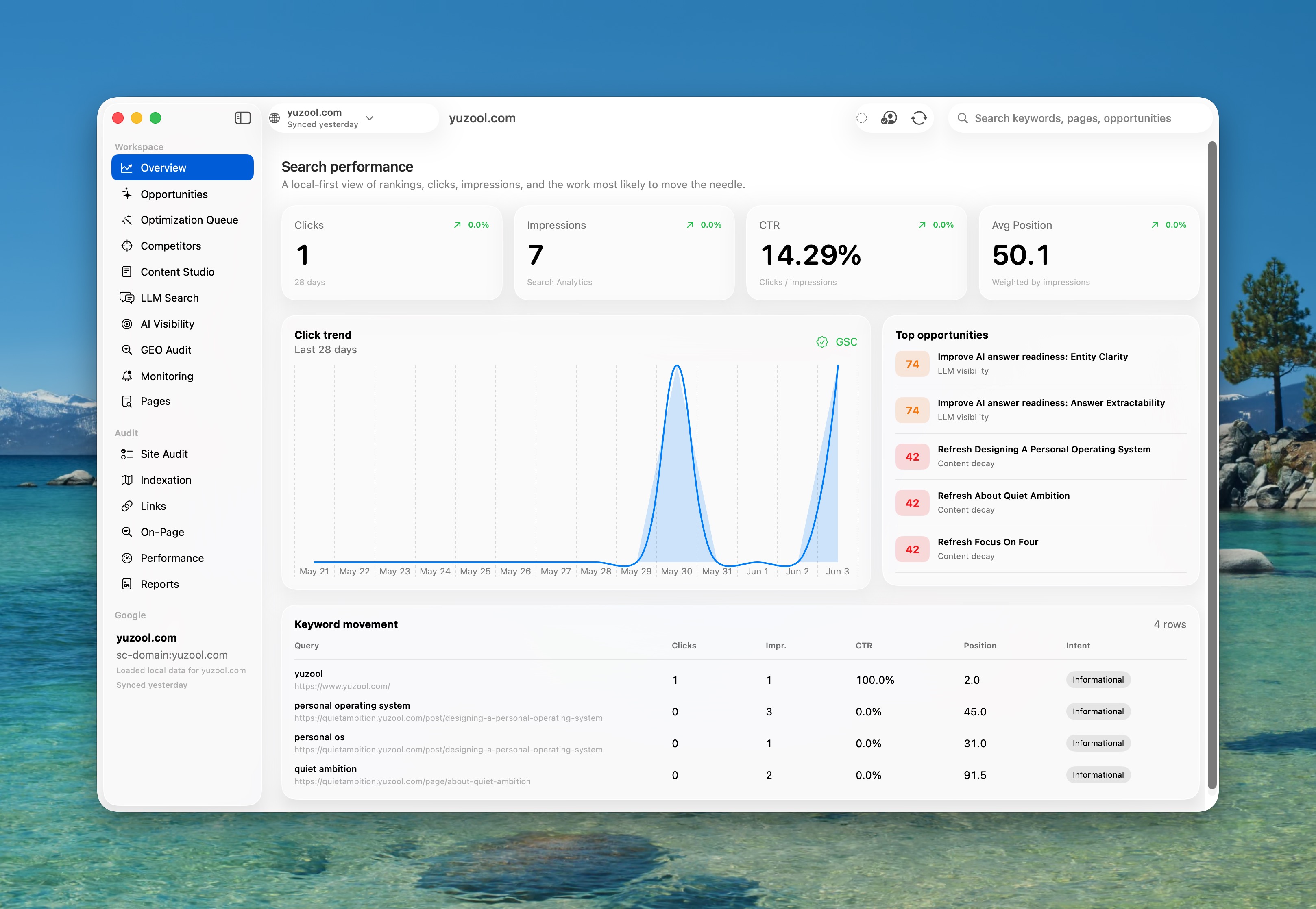
That is why my Search Console routine is deliberately narrow: one baseline, one page, one change, and one note. Rank is the Mac app I built to keep that loop close to the work.
1. Start with a seven-day baseline
On Monday I look at the last seven days and compare them with the previous period. I record impressions, clicks, click-through rate and average position for the site, then look at the pages rather than chasing a single keyword.
The baseline is not a verdict. Small sites can move around a lot, and a week is often too short to call a winner. It is simply a timestamp that tells me what I knew before making a change.
2. Find a page that is already being shown
The most useful early opportunity is usually a page with impressions but fewer clicks than its position suggests. It already has some distribution. The job is to make the result clearer when somebody sees it in search.
- Filter to pages with impressions in the selected period.
- Look for a page whose CTR is weaker than similar pages.
- Open its queries and write down the language people actually use.
- Choose one page, not a list of twenty improvements.
This is also where I separate a content problem from a technical one. If the page is not indexed, a title rewrite is not the first fix. If it is indexed and visible, the promise in the title and description may be the better experiment.
3. Make one visible change
I change the element that a searcher can understand fastest: the title, the description, the opening heading or the internal link that points to the page. The change should make the page more specific to the query, not merely add more words.
For example, “Rank — SEO tools for Mac” is broad. “Google Search Console workflow for Mac” tells a narrower searcher what the page is for. If the page is about low-CTR pages, say that plainly and show the next action.
I write the before-and-after copy in the note beside the page. This makes the experiment reversible and stops me from accidentally changing five variables at once.
4. Keep a decision note
Every weekly check ends with four short lines:
- Page: the URL I changed.
- Signal: the query, impressions or CTR that triggered it.
- Change: the exact copy or link I edited.
- Next review: the date I will look again.
This is the part that tends to disappear when SEO lives only in a browser. A report tells me what happened; the note preserves why I acted. Rank is designed around that decision layer rather than another dashboard to leave open all day.
5. Review on Friday, then leave it alone
On Friday I check whether the page received more impressions, whether the result was clearer to searchers, and whether clicks moved in the expected direction. I do not rewrite the page again because one day looks noisy. If the signal is inconclusive, I leave the change in place and set the next review.
SEO gets expensive when every visit to Search Console creates a new task. A weekly rhythm creates a smaller promise: make one useful decision, then return to building the product.
Turn the routine into public proof
I also publish a short weekly log: the baseline, the page I chose, the change, and what I learned. It is useful for me because it creates a record. It is useful for readers because they can copy the method before deciding whether they need the app.
That is the distribution loop I am trying to build at Yuzool: use the product on our own site, document a real decision, publish the evidence, and give the reader a small next step. The traffic and sales still have to prove it, but the work compounds instead of vanishing after a dashboard check.