App Store
12 Questions for an Indie App Store Launch Retrospective
Use these 12 App Store launch retrospective questions to review traffic, conversion, feedback and distribution before choosing the next experiment.
Published October 1, 2026 · Michael at Yuzool
An indie App Store launch retrospective does not need a slide deck. It needs a clear record of what you expected, what happened and what you will test next. The smaller the team, the more valuable it is to keep the review short enough to finish while the evidence is still fresh.
Start with the launch window
Write down the release date, the first meaningful update and the period you are reviewing. Record the main distribution channels: App Store search, a newsletter, an article, a directory, a social post, a Product Hunt launch or direct outreach.
Then answer these questions without explaining them away:
- What did we expect the first week to look like?
- Which audience actually visited the product page?
- Which channel sent the most relevant visitors?
- Where did visitors stop in the funnel?
The answers separate an acquisition problem from a product-page problem. A page with few visits needs distribution. A page with visits but little conversion needs clearer positioning, stronger proof or a better offer.
Review the product page as a stranger
Read the title, subtitle and first three screenshots aloud. Ask:
- Can a new visitor explain who the app is for?
- Does the first screenshot prove the main job?
- Which important question did the page leave unanswered?
- Did our price and purchase model make sense before the download decision?
Do not assume a visitor knows the feature names or the story behind the product. If support messages repeatedly explain something that belongs on the store page, that is useful evidence for the next listing change.
Use reviews and support as product research
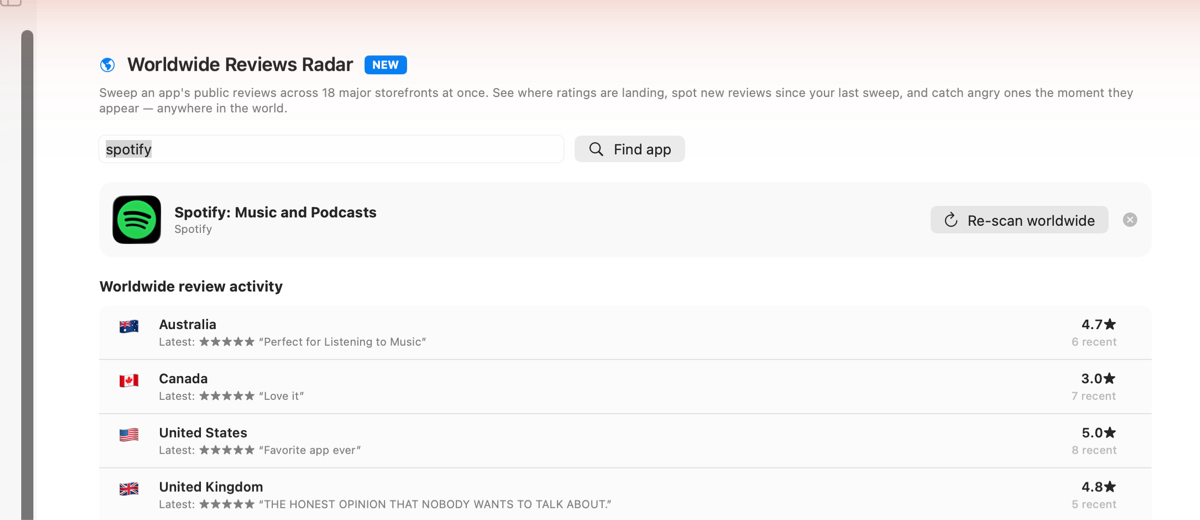
Reviews often reveal the language people use when they describe the outcome they wanted. Support messages reveal the moments where the product or page created uncertainty. Neither source should be treated as a command to add every requested feature.
Ask:
- What words did users use that we did not use in the listing?
- Which request appeared more than once?
- Which objection prevented someone from trying the app?
Dispatch helps keep this work connected: research notes, competitor observations, listing decisions and launch follow-up stay in one Mac workspace instead of disappearing across separate notes and browser tabs.
Choose one next experiment
Finish with one decision, not ten. Ask:
- What single change would teach us the most in the next two weeks?
That change might be a new subtitle, a different screenshot order, a clearer pricing explanation, a page for a specific search intent or an outreach angle aimed at a better-fit audience. Give it a time window and one success measure.
The final question is not “did the launch work?” It is “what did the launch teach us that makes the next decision better?” That is the habit that turns a one-off release into a durable distribution practice.