Technology
SaaS Free Trial vs Demo Request: Which CTA Should You Use?
Choose between a SaaS free trial and a demo request by comparing time-to-value, setup effort, buyer confidence, support needs and what you can measure.
Published September 20, 2026 · Michael at Yuzool
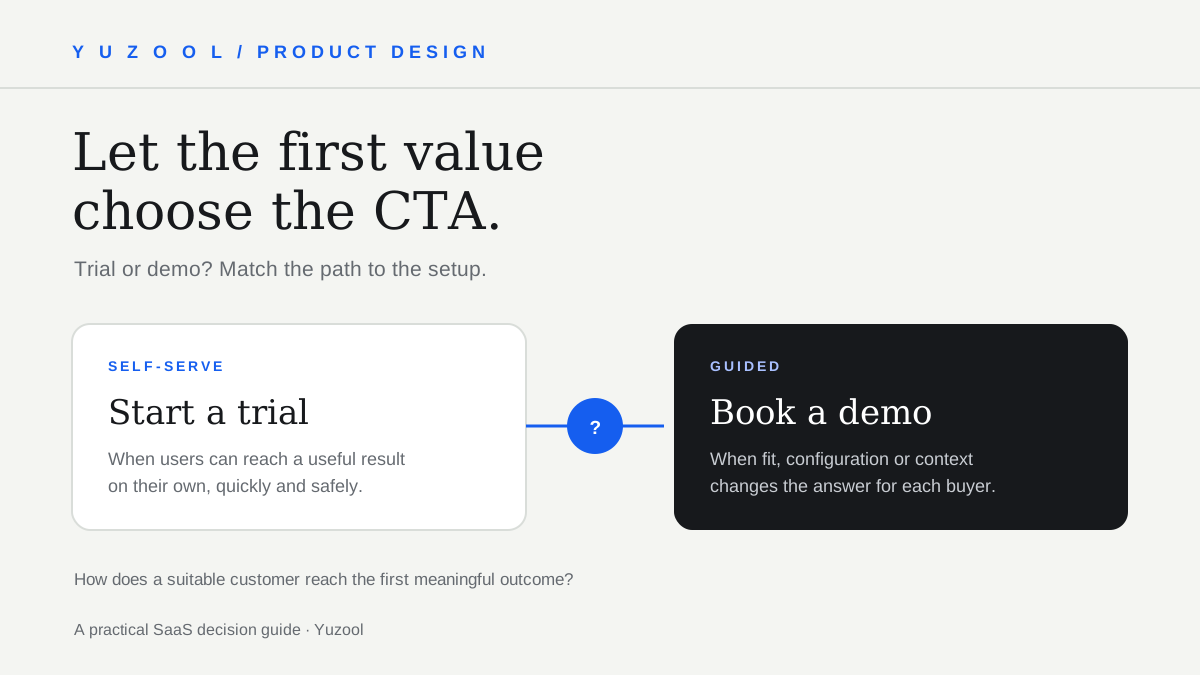
Use a free trial when a new customer can reach a meaningful product result on their own. Use a demo request when the product needs explanation, configuration or a conversation before someone can judge whether it fits. The right call to action depends less on SaaS convention and more on the first useful outcome a buyer can reach.
A trial invites someone to try the product directly, often within a limited period or feature set. A demo request asks them to arrange a guided walkthrough or conversation. Both can work; either can frustrate the wrong audience. A self-serve sign-up is not automatically low-friction if the user faces a blank workspace and confusing setup. A demo is not automatically high-touch value if it is the only way to see a basic feature.
Ask how quickly the product can prove its value
Write down the first outcome that would make a new user think, “I understand why this could help.” Then list what must happen before they reach it. If the path is short, reversible and self-explanatory, a trial can let a motivated visitor experience the value without waiting for a sales calendar.
If reaching that outcome requires importing data, connecting several systems, setting permissions or choosing a complex configuration, a blank trial may feel like work before value. A demo can be useful when a person needs help seeing the path, or when the product depends on understanding a specific use case.
The key question is not “Can we create an account?” It is “Can a suitable prospect get far enough to make a meaningful judgment without assistance?”
Choose a free trial when the product is legible by use
A trial is a strong fit when the product can guide a person to a small win with the information they already have. Give the account a useful starting state, make the first action visible and show what successful progress looks like. Avoid making visitors configure every preference before they can inspect the core workflow.
Decide what happens at the end. Explain the duration, any feature limits, whether billing details are required, and what the user keeps if they do not pay. Do not hide a cancellation or data-retention consequence inside a welcome email. A trial invitation is a promise about what someone can experience and what it will cost them in time, money and setup.
Measure more than registrations. Track whether the user reaches the first outcome, completes the essential setup, returns to the product, and encounters blockers. A large signup count can coexist with a confusing first session.
Choose a demo when context changes the answer
A demo is useful when the buying decision depends on workflow fit, permissions, integrations, migration, security review or a team-specific setup. A conversation can help a buyer ask questions that a generic trial cannot answer. It also lets the seller understand the situation before recommending a configuration.
Make the meeting useful before someone books it. State who the session is for, what it will cover, how long it takes, and whether the visitor needs to prepare anything. If the call is a qualification step rather than a product walkthrough, say so. Clear expectations reduce unpleasant surprises for both sides.
Do not ask for a demo simply because the team wants contact details. If a person can answer their core fit question by exploring the product or watching a short walkthrough, forcing a meeting can add work without adding understanding.
Use this comparison as a first decision
| Question | Trial is more likely to fit | Demo is more likely to fit |
|---|---|---|
| Can someone reach value alone? | Yes, with a short guided path | Not without context or setup |
| Does setup vary by customer? | Little or not at all | Meaningfully, by team or workflow |
| Is the main risk uncertainty about usability? | Let people try the workflow | Show the workflow with relevant context |
| Does a purchase need several stakeholders? | A trial can build internal evidence | A guided session can answer shared questions |
| Is the product understandable from its first screen? | Usually | A conversation may clarify what is hidden |
Treat this as a discussion prompt, not a universal law. Some products use both paths because customers arrive with different needs. ProductLed offers an overview of how trials and demos differ as product-led and sales-assisted routes. Read its trial-versus-demo guide.
If you offer both, make the choice meaningful
Two calls to action help only when the paths are genuinely different and the labels explain that difference. “Start free trial” can serve someone who wants to explore alone. “Talk through setup” can serve someone with a complex workflow. Two buttons that lead to nearly identical sales forms merely create another decision.
Keep the primary action visually clear. Add a short description below the secondary path, such as “For teams comparing integrations” or “Prefer a guided walkthrough?” Make sure a person can switch paths without losing information or submitting the same details twice.
Test the path, not only the button
Review the landing page, first session and follow-up together. For a trial, observe a new user attempting the first valuable task without coaching. For a demo, ask whether the page explains what will happen after the request and whether the booking process fits the buyer’s schedule.
Measure a small chain of events: qualified visitors, trial starts or demo requests, first-value completion, follow-up, and eventual purchase or explicit disqualification. Compare cohorts over enough time to account for the real buying cycle. Do not declare a winner because one button received more clicks in a day.
If prospects repeatedly start trials but need help with the same setup step, improve onboarding or offer an optional guided route. If demo requests often turn out to be poor-fit accounts, clarify the page and eligibility before asking someone to book.
The best CTA is the one that gets a suitable buyer to the evidence they need with the least unnecessary effort. Start with the product’s first useful outcome, match the route to the support it requires, and keep learning from what visitors actually do.