ShadowCoach / Product note
Why I built a private boxing coach for iPhone.
The useful part of a training app is not the number of features. It is the cue that arrives early enough to change the next repetition.
August 14, 2026 · Michael at Yuzool
I kept coming back to a small problem: solo boxing is easy to start and surprisingly hard to learn from. A timer can tell you when a round ends. A mirror can show a shape. Neither tells you whether your hands came back to guard or whether the last punch became slower because your balance went.
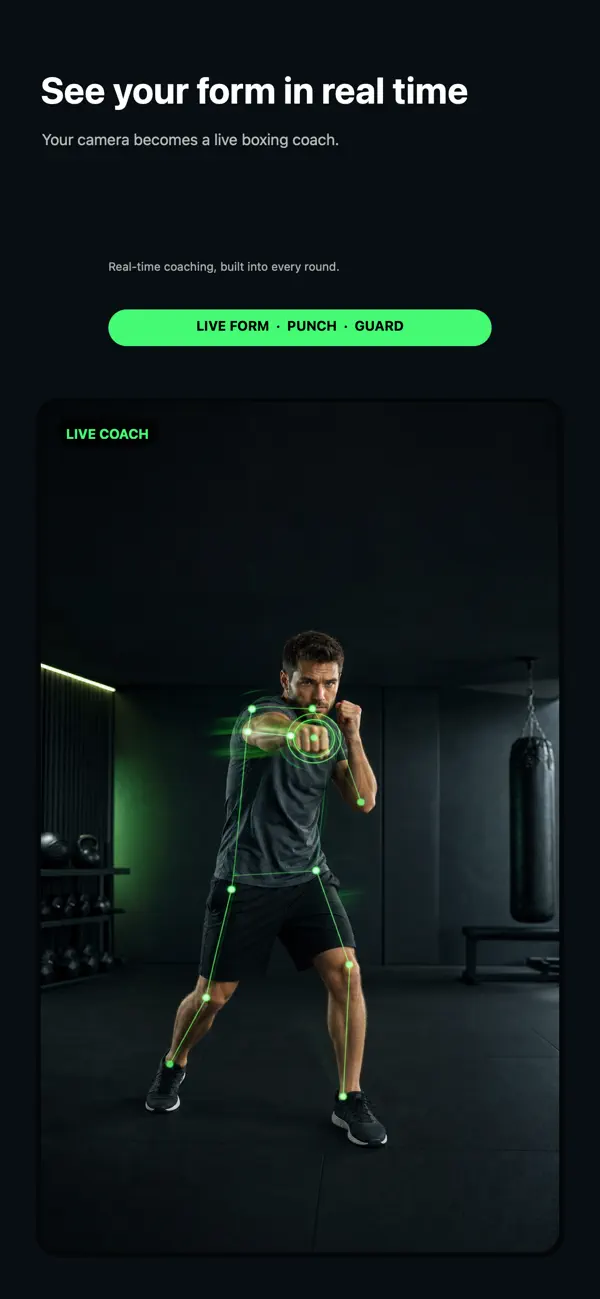
That gap became ShadowCoach, an iPhone app that watches a session locally and gives a few useful signals while you are still moving. The first version is intentionally narrower than a full fitness platform. It counts punches, measures speed and pace, and calls attention to form cues such as guard, chin and hip rotation.
The design constraint was privacy
Camera-based products often create a second problem: the user has to wonder where the footage goes. For a home workout, that is unnecessary friction. ShadowCoach keeps the live analysis on the iPhone and does not ask the boxer to create a public profile or upload a training video.
That constraint also improves the product. There is no need to build a social feed, a ranking system or a cloud video library before the basic feedback loop works. Open the app, make enough space, step into frame and train.
One cue is better than a lecture
It is tempting to add every metric a camera can estimate. In practice, a tired person cannot use twelve corrections at once. The app should help choose one intention for the next round: keep the guard high, return the hand quickly, rotate through the punch or stay balanced.
The numbers still matter, but as context. A faster punch is not automatically a better punch. A larger count is not automatically a better round. The useful question is what changed, and what should be repeated.
How I expect people to discover it
People do not usually search for a product name first. They search for the job: an AI boxing coach for iPhone, a shadowboxing app at home, a punch speed tracker or a boxing workout without equipment. Each phrase deserves a useful page that answers the question honestly and then gives the person a low-friction way to try the idea.
That is why the ShadowCoach site has short guides and free browser tools alongside the App Store page. Someone can make a form cue or plan a short session before deciding whether the app belongs in their routine. The free action is not a trick; it is a small proof of the job the paid app completes.
The first release is a conversation
Shipping the app does not prove every assumption. It gives me a way to see which promise makes someone stop, which setup step is confusing, and which feedback is genuinely useful after a week. The first purchase is encouraging, but the more important signal is whether a new boxer can understand the value before they download.
If you are building a small app, the lesson is portable: start with a repeated moment of uncertainty, make the next action clearer, and let distribution explain the job in the language people already use.