Freelance work
Weekly Planning for Freelancers With Multiple Clients
A realistic weekly planning method for freelancers managing multiple clients, competing deadlines and unfinished work without losing the shape of the week.
Published September 24, 2026 · Michael at Yuzool
Weekly planning gets more important as a freelancer takes on more clients, but the usual advice can become less useful at exactly that point. A long list of tasks does not show which client is taking the week, where the deadline collisions are or how much space remains for your own business.
The goal is not to give every client equal time. The goal is to make the trade-offs visible early enough that you can deliver good work and communicate before a promise becomes a surprise.
Start with promises, not categories
Write down the external commitments first: a review call, a draft due Wednesday, a launch check, an invoice or a handoff. These are the fixed points around which the week has to work.
Then add the next action for each promise. “Client website” is too broad to schedule. “Write the homepage outline” can fit into a morning. A clear next action also makes it easier to resume work after a meeting or interruption.
Give each client a visible colour or label
When several clients share a calendar or task list, context switching becomes expensive. A short label or colour lets you see whether Tuesday is balanced or whether one client has silently consumed every useful block.
Keep the labels simple. The point is recognition, not a new taxonomy project. You should be able to scan the week and answer: who needs attention, what is blocked and where is my own work?
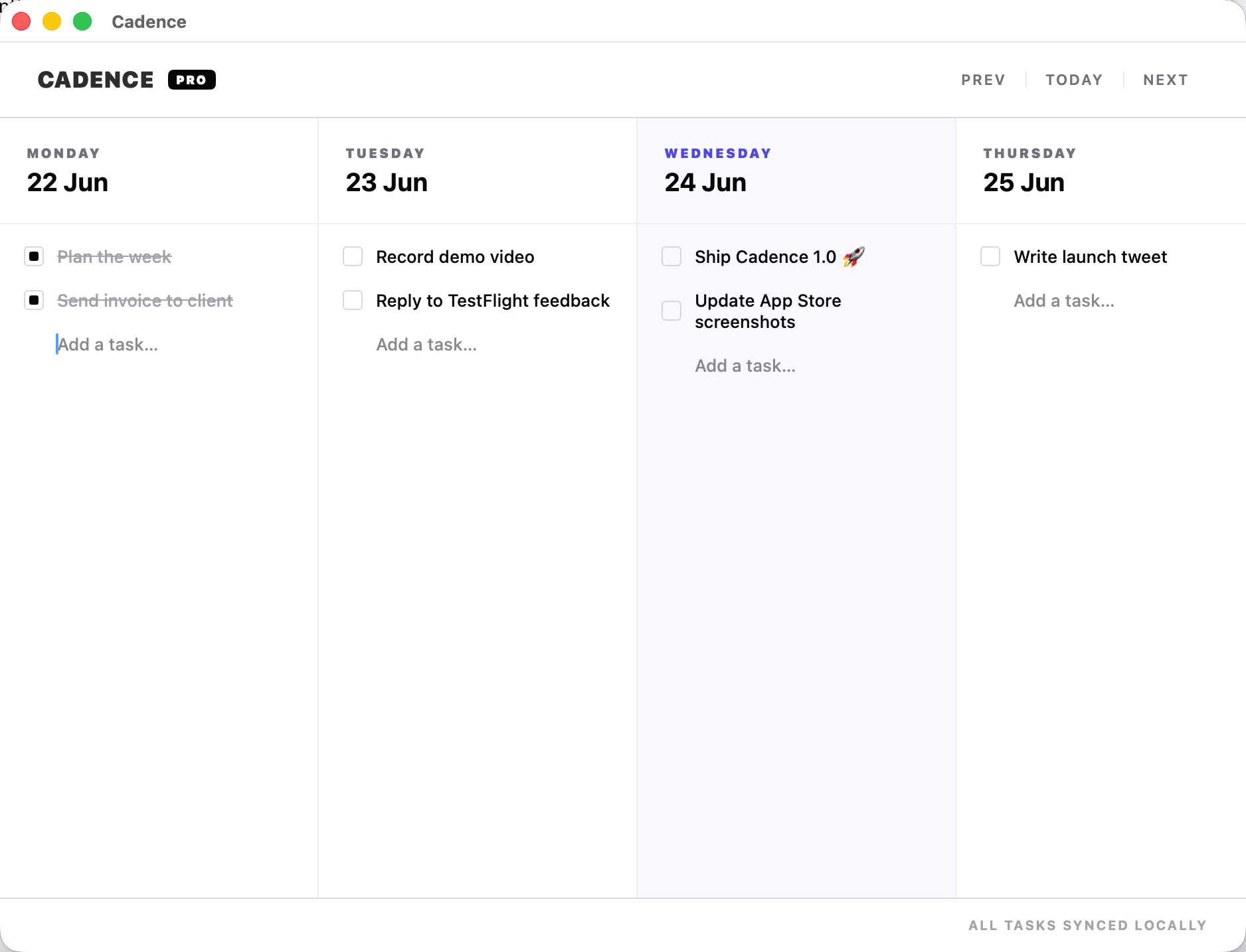
Cadence is a native Mac weekly task board for freelancers and independent workers who need to see what matters this week—and move unfinished work without starting over. Explore Cadence if you want the week itself to be the primary view, with an iPhone companion for quick checks away from your desk.
Protect a business block
Client work expands to fill every visible gap. Reserve at least one block for your own business: sending proposals, improving your portfolio, writing an article, reviewing finances or making the next product decision.
This block is not less important because it has no external deadline. It is the work that keeps next month from becoming dependent on this week’s client load. If an urgent request arrives, move the block consciously rather than letting it disappear.
Plan by capacity, not optimism
Estimate the work in hours, then reduce the available capacity. Meetings, setup, admin, replies and recovery all take time. A week with five client days rarely has five days of uninterrupted production.
A useful first pass is to plan only 70–80 percent of your actual working time. The remaining space is for the parts of freelance work that are real but difficult to predict. If you always fill the week to 100 percent, every small change becomes a late night.
Use a three-level priority system
You do not need a complicated scoring model. Try three levels:
- must move: an external promise or a blocker;
- should move: important work that prevents future pressure;
- could move: useful work with no immediate consequence.
Put must-move tasks on specific days. Keep should-move tasks visible but realistic. Let could-move tasks wait without making them look like failures. This is kinder and more accurate than calling everything urgent.
Treat unfinished work as information
When a task does not get done, do not copy it into a new list and hide the history. Move it to the next realistic day, shorten it into the next action or remove it. The movement is a signal.
If the same task moves repeatedly, ask what is wrong. It may be too large, waiting for a client, badly described or no longer worth doing. A weekly board makes these patterns easier to see because the task has a visible relationship with the days it missed.
Make communication part of the plan
Freelancers often delay a difficult client message because it feels like work about the work. Put the message on the board. “Ask for missing product copy” or “confirm review date” may be the highest-leverage task in the week because it removes a block for everything else.
Send the message while there is still time to react. A plan that includes communication is more reliable than one that assumes every dependency will resolve quietly.
Close the week with a small review
At the end of Friday, look at three things: what shipped, what moved and what needs a conversation. Do not turn the review into a performance report. Its job is to make Monday easier.
Carry forward only the next actions that still matter. If you want a calmer home for this routine, see the Cadence weekly planner for Mac, browse the Yuzool Store or use a relevant free tool for a smaller part of the workflow.
Multiple clients will always create competing claims on a freelancer’s attention. A good weekly plan does not remove that tension. It gives the tension a shape, so you can make the next decision before the week makes it for you.